

Semaglutide & Tirzepatide For Weight Loss
Semaglutide for weight loss compared to tirzepatide for weight loss
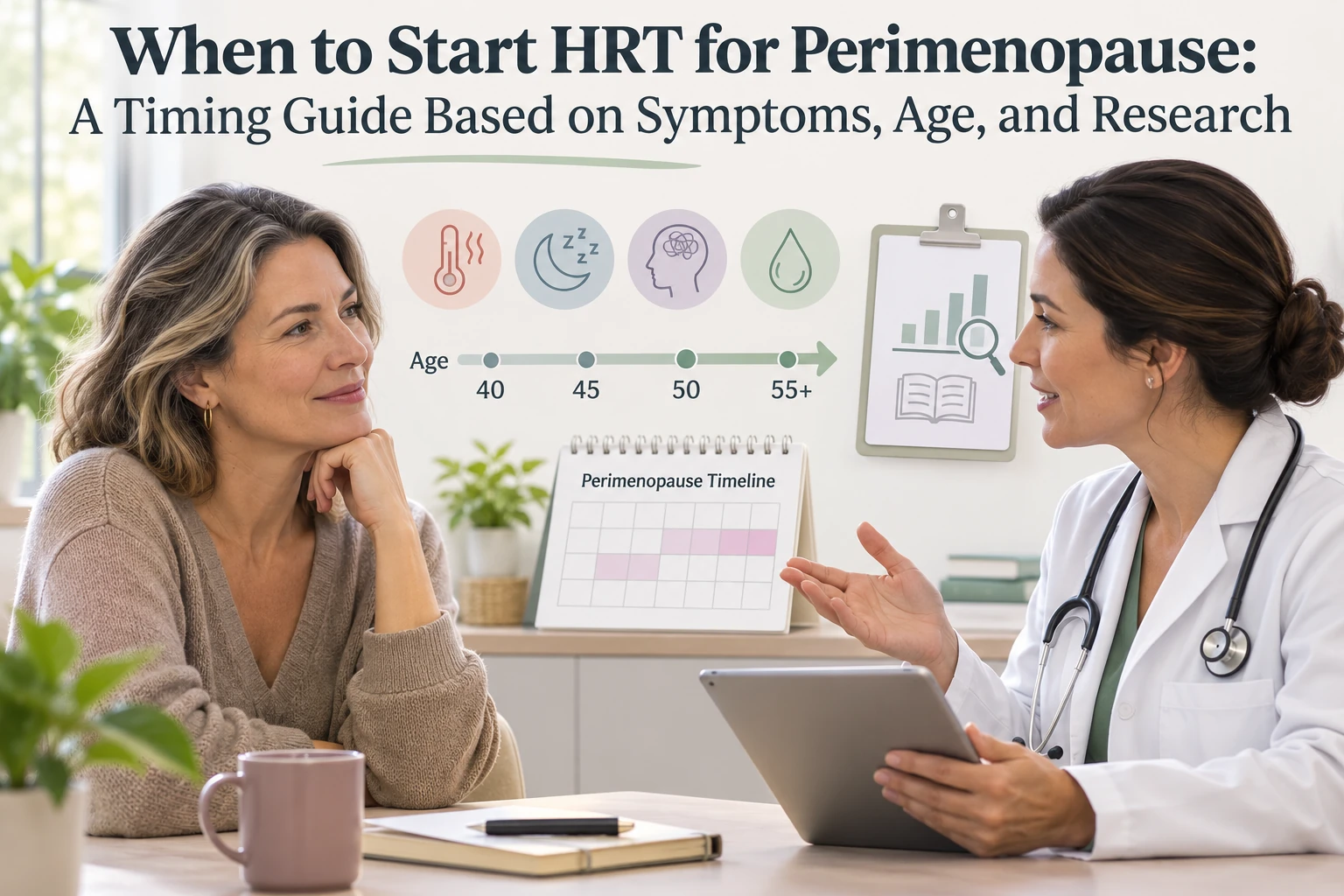
You don’t have to wait until your periods stop completely to start HRT.
Most research points to a window of opportunity: before age 60, or within about 10 years of your final period, when HRT’s benefits for symptoms, heart, and bone health tend to outweigh the risks.
The real signal isn’t a calendar date.
It’s whether perimenopause symptoms are already affecting how you sleep, feel, and function day to day.
One month your period shows up right on schedule.
The next, it’s two weeks late, or it’s suddenly heavier, or it skips you completely.
Add in a few sleepless nights and a shorter temper than usual, and it’s easy to wonder if something is wrong, or if you’re imagining all of it.
This is usually perimenopause, and it’s also usually the point where when to start HRT for perimenopause stops being a theoretical question and starts feeling urgent.
The answer isn’t tied to a single age or test result.
It comes down to how you feel, how long you’ve felt that way, and what the research actually says about timing.
SEE IF HRT IS RIGHT FOR YOUR PERIMENOPAUSE SYMPTOMS
Perimenopause is the transition leading up to menopause, when your ovaries gradually make less estrogen and progesterone.
It can start in your late 30s or 40s and last anywhere from a few months to more than a decade.
Menopause itself is a single point in time, the day that marks 12 full months without a period.
Hormone levels during this stage don’t drop in a straight line.
They swing, sometimes within the same week, which is part of why symptoms can feel so unpredictable.
Getting familiar with the basics of the menopause transition makes it easier to recognize what’s actually happening in your body instead of guessing at it.
You can start HRT for perimenopause as soon as symptoms are affecting your daily life, even while you’re still getting periods.
There’s no required age or test result to hit first.
Most current guidance points to starting before age 60, or within about 10 years of your final period, since that’s when the benefits most reliably outweigh the risks.
Clinical guidance has moved away from treating a specific birthday as the trigger.
Treatment is generally considered appropriate as soon as symptoms start interfering with daily life, whether that happens at 38 or 52.
The NHS frames it in a similar way: starting hormone replacement therapy is ultimately a personal choice made together with a healthcare provider, not a box you check once you reach a certain age.
Timing research matters, but most people don’t start looking into HRT because of a study.
They start because something feels different, and it keeps happening.
Hormonal shifts touch far more than your cycle.
Hot flashes get most of the attention, but hormonal changes during perimenopause affect sleep, mood, metabolism, and energy at the same time.
Hot flashes and night sweats are some of the most recognizable perimenopause symptoms, often showing up as sudden heat, flushing, or waking up drenched in the middle of the night.
Even a handful of these episodes a week can wreck a full night’s sleep.
Poor sleep doesn’t just make the next day harder.
Left alone, it builds up, and the fatigue that follows can be one of the more draining parts of perimenopause, chipping away at focus, patience, and motivation.
Estrogen has a direct effect on the brain chemicals that regulate mood, which is part of why mood swings often show up before hot flashes do.
Many women also notice new anxiety, irritability, or trouble concentrating that doesn’t line up with anything else going on in their lives.
For some, HRT can meaningfully ease that anxiety once hormone levels are stabilized, rather than needing to just push through it.
Periods are often the first obvious clue.
Cycles that used to show up every 28 days might shorten, lengthen, skip, or suddenly become heavier, and tracking these changes as they happen is one of the simplest ways to flag perimenopause early.
A dip in libido is common too, and it’s rarely just in your head.
Falling estrogen and testosterone both play a role in changes in sex drive during this transition.
GET HELP WITH YOUR PERIMENOPAUSE SYMPTOMS
Research presented at The Menopause Society’s 2025 Annual Meeting found that starting estrogen therapy during perimenopause, generally within about 10 years of your final period, was linked to roughly 60% lower odds of breast cancer, heart attack, or stroke compared with starting later.
This pattern is often called the timing hypothesis, or the window of opportunity.
The analysis behind that finding looked at more than 120 million patient records, comparing outcomes for women who started estrogen therapy at different points in the menopause transition.
Mayo Clinic describes a similar pattern, often called the timing hypothesis: starting hormone therapy earlier in the transition appears to carry a more favorable risk profile than starting it a decade or more after your final period.
Because perimenopause doesn’t come with one clear marker, confirming where you actually stand through hormone testing is usually more useful than estimating it from symptoms alone.
Starting HRT in your late 30s or early 40s because of genuine symptoms isn’t considered too early, especially with early or premature menopause.
Starting after age 60, or more than 10 to 20 years past your final period, doesn’t rule HRT out, but it does shift the balance of risks and benefits, so that conversation needs more care.
If you’re going through early or premature menopause, meaning periods stop before age 45, HRT or a combined contraceptive pill is typically recommended rather than optional, since your body is missing out on estrogen’s protective effects earlier than expected.
Starting much later in life changes the calculation differently.
The balance between benefit and risk shifts after age 60, largely because cardiovascular risk factors have had more time to build before treatment even starts.
Most of the fear around HRT traces back to older research and boxed warnings that oversimplified a complicated risk picture.
In 2025, an FDA panel voted to remove misleading boxed warnings from several HRT medications, acknowledging that the actual risk profile is far more nuanced than the labels suggested.
That said, HRT isn’t the right fit for everyone.
People with a history of estrogen-sensitive cancer, unexplained vaginal bleeding, active blood clots, or certain liver conditions are usually advised to explore other options first.
A lot of the fear doesn’t hold up once you look at what the current research actually shows about hormone therapy, but a provider still needs to review your personal and family health history before you start.
Guessing isn’t a great strategy when it comes to hormones, which is why our approach starts with data instead of assumptions.
A full hormone panel maps out exactly where your estrogen, progesterone, and related markers stand right now, instead of relying on symptoms alone to make the call.
From there, treatment plans are built around bio-identical hormone therapy tailored to your labs, symptoms, and goals rather than a one-size-fits-all dose.
For some patients, peptide support rounds out a plan that’s also addressing sleep, metabolism, or recovery.
You can work with our team in person through our hormone therapy program in Santa Barbara, or remotely through our virtual concierge option if an in-person visit isn’t practical.
Either way, the goal is the same: find out where you actually stand, then build a plan around that instead of a guess.
Most people notice fewer or milder hot flashes and night sweats within two to four weeks of starting HRT.
Sleep, mood, and energy usually take a bit longer to catch up, with fuller benefits typically showing up around two to three months in.
Vasomotor symptoms, the hot flashes and night sweats, are usually the first to ease.
Other improvements take a bit more patience to show up as hormone levels stabilize.
Dosing isn’t usually perfect on the first try, and that’s expected.
Providers typically check in and adjust as needed, which is also how you’ll start noticing clear signs that treatment is actually working rather than wondering if anything is happening at all.
There’s no single perfect moment that guarantees the right time to start HRT for perimenopause.
But there is a point where symptoms stop being a minor inconvenience and start shaping your sleep, your mood, and your everyday life, and that point is usually the signal worth acting on.
If that sounds familiar, Eternity Health Partners can help you find out what’s actually happening with your hormones and build a plan around it, whether that ends up being HRT, a complementary approach, or simply clearer answers than you have right now.
Yes. You don’t need to wait for periods to stop completely. Many people start HRT during perimenopause specifically because irregular cycles and other symptoms are already disruptive, and current guidance doesn’t require a specific test result or final period before starting.
It generally refers to starting hormone therapy before age 60 or within about 10 years of your final period. Research suggests this window is linked to a more favorable balance of benefits and risks compared with starting later.
No, not if you’re experiencing genuine perimenopause symptoms. If periods stop before age 45, HRT is often specifically recommended rather than optional, since early estrogen loss carries its own risks.
It depends on how long it has been and your overall health. Starting many years after your final period, especially after age 60, shifts the balance of risks and benefits, so it needs a more individualized conversation with a provider rather than a flat yes or no.
Many people notice improvement in hot flashes and night sweats within two to four weeks. Sleep, mood, and energy usually take longer, with fuller benefits often showing up around two to three months in.
Sometimes the dose or formulation needs adjusting rather than the treatment itself. If symptoms aren’t improving after a few months, there are specific signs that point to whether it is a dosing issue or something else, and a provider can adjust from there.
There’s no universal cutoff. How long you can safely stay on treatment depends on your symptoms, goals, and health profile rather than a fixed number of years, and it’s typically reviewed with your provider on a regular basis.
Eternity Health Partners helps men and women reclaim lost energy and vigor, sharpen thinking, improve memory, decrease body fat
Semaglutide for weight loss compared to tirzepatide for weight loss
If you are looking to maintain or improve sexual function, you are not alone. Many men and women seek ways
Good news, you can steal back a few youthful qualities and enhance your vibrancy. All you need is due diligence
Prior to joining the team at Eternity Health Partners, Dr. Harmony worked alongside an MD in a busy General Practice clinic that specialized in primary care for all patients, as well as Hormone Replacement Therapy, regenerative joint injections, peptide injections, ozone treatments, hyperbaric oxygen therapy, and weight management. As a skilled diagnostician, Dr. Harmony has helped hundreds of patients to optimize their health with both Western medicine treatments and natural therapies.
As a Naturopathic Doctor with a diverse background in various healing arts, Dr. Harmony believes that people are multi-dimensional, thus existing as physical, mental, emotional, and spiritual beings simultaneously. Healing therefore should also be multi-dimensional, encompassing every aspect of health and well-being. Dr. Harmony is excited to work with patients at Eternity Health Partners because the treatment modalities can improve every aspect of their lives.
Liz started doing personal blood draws after her son, Dashiell, was born with Zellwegers disease. His diagnosis required numerous blood draws and drug levels throughout his life. After sitting through long wait times at the labs followed by watching many different phlebotomists, many new to the job, struggle to find his veins, often poking him multiple times, as a seasoned phlebotomist, Liz decided to draw his blood at home and hand deliver it to the lab myself. Soon after she began doing personal touch blood draws so she can now offer that same personalized service to you.
Liz graduated from Pepperdine University with a degree in Biology in 1994. She moved to Santa Barbara and earned her phlebotomy certificate in 1995. Liz began working at St. Francis Medical Center in the Physical Therapy Department and quickly transferred to the Laboratory. Perfecting her venipuncture techniques on all floors of the hospital, including post-operative patients, pregnant women going into labor, sick or premature babies, and emergency room patrons, she then improved her patient care skills working for internal medicine doctors, one of whom was the Medical Director of Hospice and won Doctor of the Year. In 1999, Liz started working with a group of local retinal surgeons. Her primary job consisted of injecting dye into arm veins and photographing its flow through the patients retinal vessels. When patients are worried about their diagnosis or apprehensive about the procedure because of difficult veins, her quick, almost pain free needle stick and kind but professional bed side manner would put them at ease.
The various settings and patients Liz has encountered over the years have enabled her to become very skilled at finding the smallest and most fragile of vessels. Her specialities include infants and the elderly, diabetics of all ages, patients with rolling veins, on blood thinners or chemotherapy. She lives in downtown Santa Barbara, travels from Goleta to Carpintera and brings all the necessary supplies directly to you. All she needs from you is a lab request and your home or office becomes an instant draw station. Appointment times are very flexible, and she is friendly, reliable and punctual. Be kind to your arm and treat yourself to the luxury blood draw you deserve!!!
Mike brings more than just a medical perspective to his clients; at the age of 14, he began an athletic career as a pole-vaulter that would end up taking him on an incredible journey over the next 13 years of his life. Throughout his athletic journey Mike was constantly working to find the ideal balance of fitness and proper nutrition in order to maximize his performances. Combined with his medical knowledge the years of athletic experience provide a unique and successful combination that serve to benefit his staff and clients.
“After I shifted the focus of my practice from Sports Medicine into Nuclear Medicine specifically Interventional Endocrinology. I found myself questioning our western medical paradigm…Here I was performing thyroid cancer and Hyperthyroidism treatments with harmful radical thyroid radioactive ablations which really made me take a hard look in the mirror and become more of a researcher to find safer and more effective options to better treat my clients. During my research I realized that there were very few, if any, medically directed programs focused towards achieving a “Healthier Lifestyle” rather than typical “Diet” fads.” A few years later after training and working with some of the worlds foremost Bio-identical Hormone Replacement specialists I became Board Certified in Anti-Aging and Regenerative Medicine. Sort of just found my passion and the answers I had been looking for with this new specialty finally after years of treating people with the Band-Aid “fix it when its broken” mentality instead of at the root cause.”
Mike has spent the last 10 years in Anti-Aging, Functional and Regenerative Medicine. He has trained over 120 physicians in Anti-Aging and Regenerative Medicine and consulting for their practices. Today his vision is a reality, and clients from all of the world come to benefit from the successful programs that have been established at Age Management Institute Santa Barbara. He firmly believes in educating the patient about the importance of good nutrition, hormone balance, stress management, and regular exercise is the key to aging well and having a high quality of life well into your golden years.