

Semaglutide & Tirzepatide For Weight Loss
Semaglutide for weight loss compared to tirzepatide for weight loss
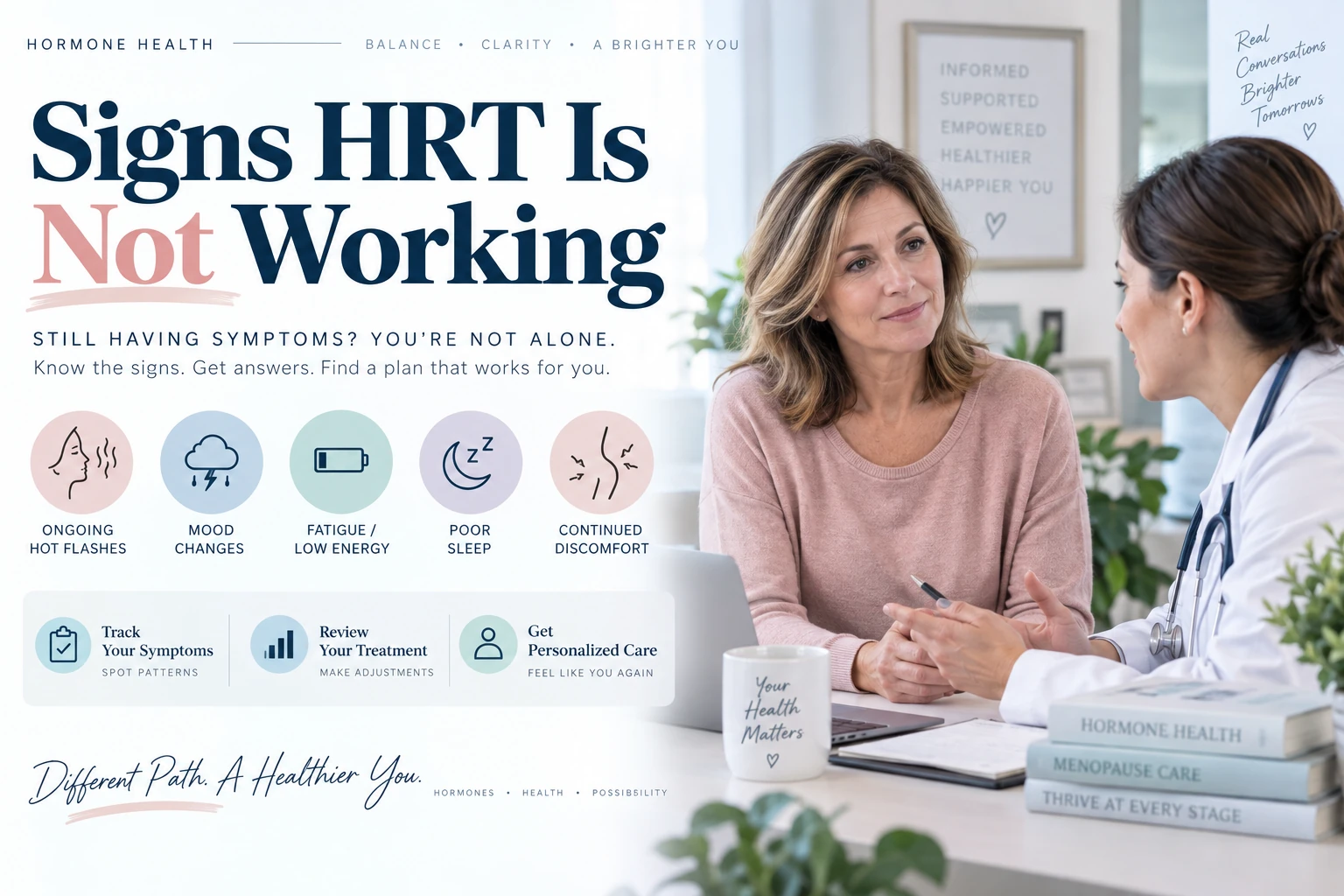
If your hot flashes, sleep, or mood haven’t improved after three months on HRT, the problem is usually your dose, hormone type, or delivery method, not a sign that HRT can’t work for you.
This guide walks through the real signs your HRT isn’t working, why it happens, and what steps actually help.
You started HRT hoping to feel like yourself again, and for a while, maybe you did.
But if the hot flashes are back, sleep still feels impossible, or nothing has really changed at all, you’re probably searching for the signs HRT is not working and wondering what to do about it.
The good news is that ineffective HRT is usually fixable.
It’s rarely a reason to give up on treatment altogether.
That confusion is common.
Hormone therapy is not one size fits all, and what works well for one person’s set of symptoms can fall flat for someone else on the exact same medication.
Knowing what to look for, and what usually causes it, is the first step toward getting your treatment back on track.
Most people notice some relief within four to six weeks of starting HRT, but it can take up to three months for hormone levels to reach a steady state in the blood.
Hot flashes and sleep problems tend to improve first.
Mood, brain fog, and vaginal dryness often take longer to shift.
This timeline matters because plenty of people assume HRT has failed when really their body just needs more time.
The NHS notes that most side effects and adjustment periods settle within the first three months of starting or changing a dose.
If you’re only a few weeks in, it’s worth tracking when a noticeable difference typically shows up before deciding anything needs to change.
It also helps to know what it looks like when treatment is on track, so you have something to compare your own experience against instead of guessing.
The clearest sign your HRT isn’t working is that your original symptoms haven’t improved after three months, or they’re getting worse instead of better.
That can show up as ongoing hot flashes, disrupted sleep, mood changes, brain fog, low libido, or vaginal dryness that hasn’t budged.
Watch for these signs in particular:
One or two of these on their own might just mean you need a little more time.
Several of them together, especially past the three-month mark, usually mean something about your protocol needs adjusting.
GET HELP WITH YOUR HRT TREATMENT
HRT usually falls short for one of a few reasons: the dose is too low, the delivery method isn’t absorbing the way it should, smoking is interfering with oral estrogen, or something unrelated to menopause is causing the symptoms.
All of these are fixable once you know which one applies to you.
Some of this comes down to old habits.
For decades, doctors prescribed conservative, lower doses partly out of caution tied to decades-old safety warnings that overstated the risks of hormone therapy for most healthy women.
Now that those outdated FDA warnings are being removed, providers have more room to prescribe doses that actually match what a patient needs.
This is the single most common reason HRT doesn’t seem to work.
Research published in Mayo Clinic Proceedings found that side effects like breast tenderness and bleeding often resolve simply by changing the dose, route, or type of hormone, not by stopping treatment altogether.
If your symptoms are still hanging around, it’s worth asking whether your dose needs a second look rather than assuming HRT itself isn’t for you.
Pills, patches, gels, and pellets don’t all behave the same way in your body.
Oral estrogen passes through your liver before it reaches your bloodstream, which means a meaningful portion of the dose gets broken down before it can do its job.
Patches, gels, and other transdermal options skip that step, so some people feel a noticeable difference just by switching how they take their hormones.
If you smoke and take oral estrogen, that combination may be working against you.
Smoking speeds up how quickly your liver breaks down oral estrogen, and studies have found reductions in estrogen levels of up to 50 percent in postmenopausal smokers compared with non-smokers on the same dose.
Switching to a transdermal option often sidesteps this problem entirely.
Fatigue, brain fog, and weight changes overlap heavily with thyroid problems, and the two get confused often.
Thyroid disease symptoms are practically identical to menopause symptoms, which means a thyroid issue can easily get blamed on hormone therapy that’s actually working just fine.
A simple blood panel can rule this out, and if your labs do point to a broader imbalance, correcting the underlying hormone imbalance often resolves symptoms that HRT alone never will.
Vaginal dryness is one of the least responsive symptoms to systemic HRT (pills, patches, or pellets that treat your whole body) because very little of that hormone reaches vaginal tissue directly.
Local vaginal estrogen, used alongside systemic HRT, treats this symptom far more effectively.
This is a common blind spot.
Someone can feel great everywhere else, hot flashes gone and sleep back to normal, and still deal with dryness and discomfort during sex because systemic hormone therapy just isn’t built to fully reach that tissue.
Research comparing the two approaches found that systemic HRT resolves vaginal dryness in about 75 percent of cases, while local vaginal therapy resolves it in 80 to 90 percent of cases.
For a lot of people, combining both is what finally closes the gap.
Most HRT adjustment issues are not emergencies, but some symptoms need immediate medical attention.
Call your doctor or seek urgent care for sudden leg pain or swelling, chest pain, shortness of breath, a severe headache unlike any you’ve had before, or sudden vision changes.
These can be signs of a blood clot, stroke, or other serious complication, and they’re separate from the ordinary “still adjusting” symptoms covered above.
The NHS notes that these more serious risks are uncommon, but they’re exactly why any changes to your HRT, including stopping it, should happen with your provider’s guidance rather than on your own.
Start by giving your body an honest window of time.
Write down your symptoms for two to three weeks, noting what’s better, worse, or unchanged.
That record is far more useful to your provider than trying to recall vague impressions during an appointment.
Don’t increase your own dose or switch products without guidance, even if you’re sure you know what the problem is.
What feels like the right fix can sometimes make things harder to sort out later.
Book a follow-up appointment and ask about repeating your bloodwork to see where your hormone levels actually stand.
Lab results take the guesswork out of deciding whether you need a higher dose, a different hormone type, or a new delivery method altogether.
If your current hormone therapy isn’t giving you the relief you expected, Eternity Health Partners can help you figure out why.
We start with comprehensive lab testing rather than guesswork, so any changes to your protocol are based on where your hormone levels actually sit today, not where they were when you first started treatment.
Our approach to personalized hormone therapy uses quality bioidentical hormones and adjusts dose, type, and delivery method based on how your body responds, not a fixed protocol everyone follows the same way.
If dosing, absorption, or an unrelated condition is behind your symptoms, we’ll help you sort out which one it is and what to do about it.
A consultation is the easiest way to get a clear answer instead of continuing to guess.
Ineffective HRT is frustrating, but it’s rarely a dead end.
Most of the time, a closer look at your dose, delivery method, or lab results uncovers a fixable reason, and Eternity Health Partners can walk you through exactly what that looks like for your body.
Yes. Hormone needs can shift over time due to aging, weight changes, or new health conditions, so a dose that worked well for a year or two can eventually stop being enough. This usually means your protocol needs updating, not that HRT has failed for good.
No. Stopping HRT suddenly can bring symptoms back quickly, and sometimes more intensely than before you started. Any changes, including stopping treatment, should happen with your provider so your body can adjust safely.
Not always. A higher dose helps when the current one is genuinely too low, but if the real issue is your delivery method, smoking, or an unrelated condition like a thyroid problem, more of the same hormone won’t solve it. That’s why bloodwork matters before adjusting anything.
Bioidentical hormones are structurally identical to the hormones your body produces naturally, which can make them easier for some people to process and respond to. Switching from a synthetic formulation to a bioidentical one is one option worth discussing if standard HRT hasn’t given you relief.
Yes. Smoking, in particular, can significantly reduce how much oral estrogen actually reaches your bloodstream. Diet, stress, and sleep habits also influence how well your body responds to hormone therapy, even when the prescription itself is right.
HRT doesn’t have an expiration date, but your needs can change over the years, which is why ongoing monitoring matters. Many people safely stay on some form of hormone therapy for years as long as their dose and type keep pace with how their body changes.
Eternity Health Partners helps men and women reclaim lost energy and vigor, sharpen thinking, improve memory, decrease body fat
Semaglutide for weight loss compared to tirzepatide for weight loss

If you are looking to maintain or improve sexual function, you are not alone. Many men and women seek ways

Good news, you can steal back a few youthful qualities and enhance your vibrancy. All you need is due diligence
Prior to joining the team at Eternity Health Partners, Dr. Harmony worked alongside an MD in a busy General Practice clinic that specialized in primary care for all patients, as well as Hormone Replacement Therapy, IV therapy, regenerative joint injections, peptide injections, ozone treatments, hyperbaric oxygen therapy, and weight management. As a skilled diagnostician, Dr. Harmony has helped hundreds of patients to optimize their health with both Western medicine treatments and natural therapies.
As a Naturopathic Doctor with a diverse background in various healing arts, Dr. Harmony believes that people are multi-dimensional, thus existing as physical, mental, emotional, and spiritual beings simultaneously. Healing therefore should also be multi-dimensional, encompassing every aspect of health and well-being. Dr. Harmony is excited to work with patients at Eternity Health Partners because the treatment modalities can improve every aspect of their lives.
Liz started doing personal blood draws after her son, Dashiell, was born with Zellwegers disease. His diagnosis required numerous blood draws and drug levels throughout his life. After sitting through long wait times at the labs followed by watching many different phlebotomists, many new to the job, struggle to find his veins, often poking him multiple times, as a seasoned phlebotomist, Liz decided to draw his blood at home and hand deliver it to the lab myself. Soon after she began doing personal touch blood draws so she can now offer that same personalized service to you.
Liz graduated from Pepperdine University with a degree in Biology in 1994. She moved to Santa Barbara and earned her phlebotomy certificate in 1995. Liz began working at St. Francis Medical Center in the Physical Therapy Department and quickly transferred to the Laboratory. Perfecting her venipuncture techniques on all floors of the hospital, including post-operative patients, pregnant women going into labor, sick or premature babies, and emergency room patrons, she then improved her patient care skills working for internal medicine doctors, one of whom was the Medical Director of Hospice and won Doctor of the Year. In 1999, Liz started working with a group of local retinal surgeons. Her primary job consisted of injecting dye into arm veins and photographing its flow through the patients retinal vessels. When patients are worried about their diagnosis or apprehensive about the procedure because of difficult veins, her quick, almost pain free needle stick and kind but professional bed side manner would put them at ease.
The various settings and patients Liz has encountered over the years have enabled her to become very skilled at finding the smallest and most fragile of vessels. Her specialities include infants and the elderly, diabetics of all ages, patients with rolling veins, on blood thinners or chemotherapy. She lives in downtown Santa Barbara, travels from Goleta to Carpintera and brings all the necessary supplies directly to you. All she needs from you is a lab request and your home or office becomes an instant draw station. Appointment times are very flexible, and she is friendly, reliable and punctual. Be kind to your arm and treat yourself to the luxury blood draw you deserve!!!
Mike brings more than just a medical perspective to his clients; at the age of 14, he began an athletic career as a pole-vaulter that would end up taking him on an incredible journey over the next 13 years of his life. Throughout his athletic journey Mike was constantly working to find the ideal balance of fitness and proper nutrition in order to maximize his performances. Combined with his medical knowledge the years of athletic experience provide a unique and successful combination that serve to benefit his staff and clients.
“After I shifted the focus of my practice from Sports Medicine into Nuclear Medicine specifically Interventional Endocrinology. I found myself questioning our western medical paradigm…Here I was performing thyroid cancer and Hyperthyroidism treatments with harmful radical thyroid radioactive ablations which really made me take a hard look in the mirror and become more of a researcher to find safer and more effective options to better treat my clients. During my research I realized that there were very few, if any, medically directed programs focused towards achieving a “Healthier Lifestyle” rather than typical “Diet” fads.” A few years later after training and working with some of the worlds foremost Bio-identical Hormone Replacement specialists I became Board Certified in Anti-Aging and Regenerative Medicine. Sort of just found my passion and the answers I had been looking for with this new specialty finally after years of treating people with the Band-Aid “fix it when its broken” mentality instead of at the root cause.”
Mike has spent the last 10 years in Anti-Aging, Functional and Regenerative Medicine. He has trained over 120 physicians in Anti-Aging and Regenerative Medicine and consulting for their practices. Today his vision is a reality, and clients from all of the world come to benefit from the successful programs that have been established at Age Management Institute Santa Barbara. He firmly believes in educating the patient about the importance of good nutrition, hormone balance, stress management, and regular exercise is the key to aging well and having a high quality of life well into your golden years.