

Semaglutide & Tirzepatide For Weight Loss
Semaglutide for weight loss compared to tirzepatide for weight loss
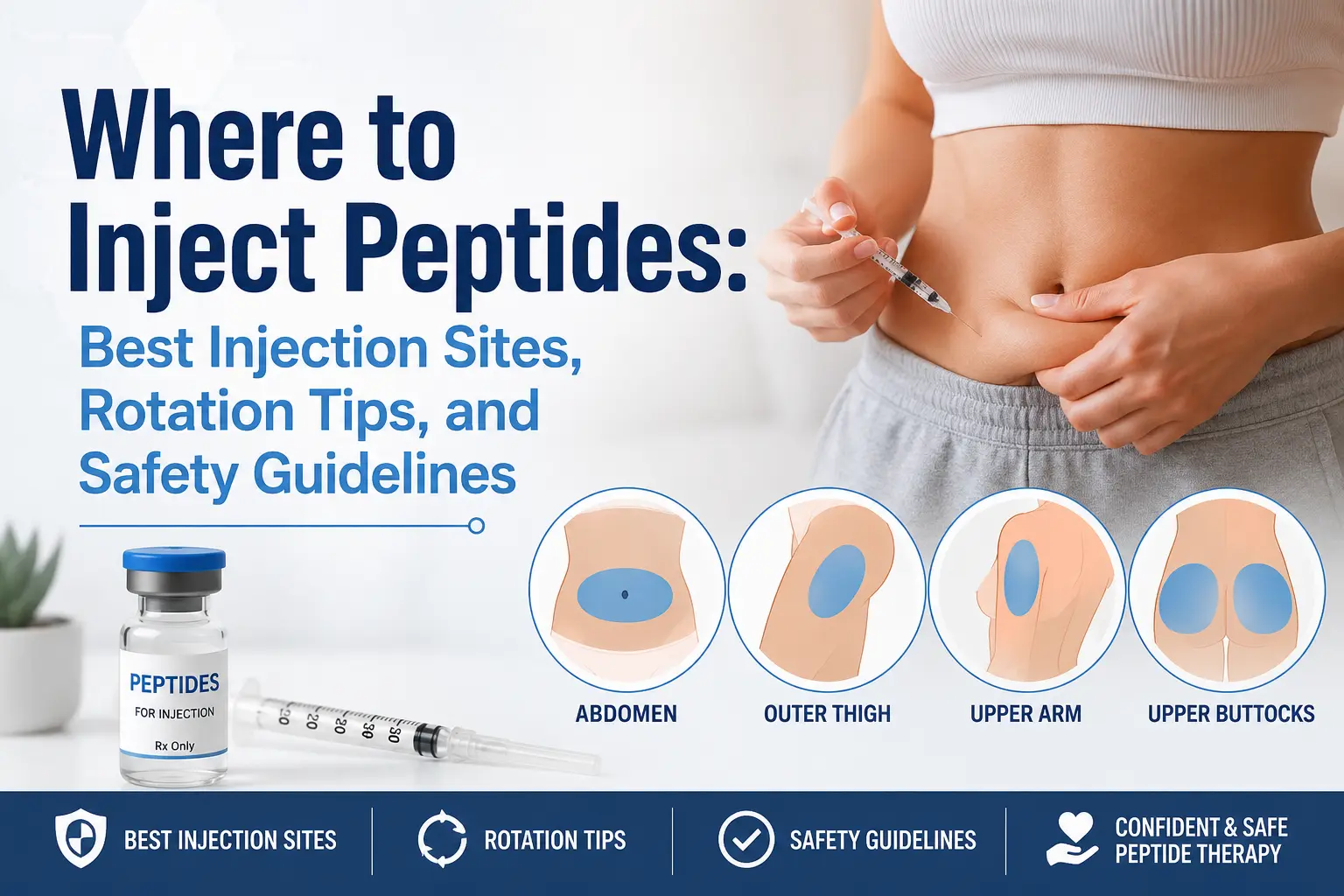
If you’re starting peptide therapy, one of the first questions you’ll likely ask is where to inject peptides.
The short answer is that most peptides are injected into subcutaneous fat, typically in the abdomen, outer thigh, back of the upper arm, or upper buttocks.
For most people, the abdomen is the preferred location because it is easy to access, comfortable, and provides consistent absorption.
However, the best injection site can vary depending on the peptide you’re using, your body composition, and your personal comfort level.
In this guide, we’ll cover the best peptide injection sites, whether injection location affects results, how to rotate sites safely, and answers to some of the most common questions patients have about peptide injections.
For most peptide therapies, the best place to inject peptides is the abdomen, specifically the fatty tissue located at least one to two inches away from the belly button.
Other common peptide injection sites include:
These areas contain sufficient subcutaneous fat and are commonly recommended for self-administered injections.
Peptides are often administered through subcutaneous injections because this method allows the medication to be absorbed gradually into the bloodstream.
Subcutaneous tissue sits between the skin and muscle and contains small blood vessels that help transport medication throughout the body.
Many commonly prescribed peptides are designed for subcutaneous administration, including:
Compared to oral administration, injections help preserve peptide stability and allow the body to absorb the medication more effectively.
One of the most frequently searched questions is whether peptide injection location affects results.
For most peptides, the answer is no.
Once absorbed, peptides enter the bloodstream and circulate throughout the body.
This means the peptide’s benefits are generally not limited to the area where the injection was administered.
However, injection location can affect:
For most patients, choosing a site that is comfortable and easy to rotate is more important than selecting a specific body area.
Let’s look at where peptides are typically injected:
The abdomen is the most commonly recommended peptide injection site.
Benefits of abdominal injections include:
When injecting into the abdomen:
For many patients, this is the simplest and most comfortable option.
The outer thigh is another excellent location for peptide injections.
Many patients use the thigh when they want additional rotation sites or prefer not to inject into the abdomen.
The best area is usually the front or outer portion of the thigh where there is sufficient fatty tissue.
The back of the upper arm can also be used for peptide injections.
This area provides another useful site for rotation but may be more difficult to reach without assistance.
The upper buttocks contain a generous amount of subcutaneous tissue and can be an effective injection location.
While less common than abdominal injections, this area can help prevent overuse of other sites.
For most people, either location can work well.
The abdomen is often preferred because:
The thigh may be a better option if:
Ultimately, both areas are commonly used and effective for peptide therapy.
This question frequently comes up among patients using peptides for recovery, joint support, or injury rehabilitation.
Many people believe peptides should be injected directly into or near the injured area.
In reality, many peptides work systemically after entering the bloodstream.
This means they travel throughout the body rather than remaining concentrated at the injection site.
For example, patients often ask where to inject BPC-157.
While some providers recommend administering BPC-157 near the area of concern, others recommend standard subcutaneous injection sites such as the abdomen.
Treatment recommendations vary depending on the patient’s goals and provider preferences.
The safest approach is to follow your healthcare provider’s instructions rather than choosing injection locations based on online advice.
Let’s look at some specific peptides and where they are typically injected:
BPC-157 is commonly administered subcutaneously.
Depending on your treatment plan, your provider may recommend the abdomen or another specific location.
CJC-1295 is typically administered into subcutaneous fat, most commonly in the abdomen or thigh.
Ipamorelin is usually injected subcutaneously into the abdomen, thigh, or another approved injection site.
Sermorelin injections are most often administered in the abdominal area, although other subcutaneous injection sites may also be appropriate.
Many weight loss peptides are administered in the abdomen due to convenience and consistent absorption.
The thighs and upper arms may also be used as part of a rotation schedule.
Avoid injecting into:
Selecting healthy skin can improve comfort and help ensure proper absorption.
Repeatedly injecting into the same location can increase irritation and may contribute to tissue changes over time.
A simple rotation schedule can help maintain healthy tissue and improve long-term comfort.
Example rotation:
| Day | Injection Site |
| Monday | Right Abdomen |
| Tuesday | Left Abdomen |
| Wednesday | Right Thigh |
| Thursday | Left Thigh |
| Friday | Right Upper Arm |
| Saturday | Left Upper Arm |
| Sunday | Different Area of Abdomen |
Even within the same body region, try not to use the exact same spot repeatedly.
Always follow the instructions provided by your healthcare provider.
The general process includes:
Thoroughly wash your hands before handling supplies.
Prepare:
Disinfect the skin using an alcohol swab and allow it to dry.
Gently pinch a fold of subcutaneous tissue.
Insert the needle according to the instructions provided with your treatment.
Administer the peptide slowly and steadily.
Place used needles in an approved sharps disposal container.
Here are some common mistakes people make when first starting peptide therapy:
Always follow the directions provided by your healthcare provider.
If you have any questions about your peptide protocol contact us at Eternity Health Partners today.
Knowing where to inject peptides can make treatment more comfortable, consistent, and easier to manage.
For most people, the abdomen remains the preferred injection site, but the thighs, upper arms, and upper buttocks are also commonly used.
The most important factors are using proper injection technique, rotating sites regularly, and following your healthcare provider’s instructions.
If you’re unsure about the best injection location for your specific peptide therapy, consult a provider like Eternity Health Partners before making changes to your treatment routine.
For most people, the abdomen is considered the best place to do peptide injections because it is easy to access, contains adequate subcutaneous fat, and typically provides consistent absorption. Other common injection sites include the outer thigh, back of the upper arm, and upper buttocks.
You should avoid injecting peptides into bruised skin, scar tissue, stretch marks, areas of active inflammation, infected skin, visible veins, or locations that are tender or painful. Injecting into damaged tissue may increase discomfort and affect absorption.
Most peptides are designed to be injected into subcutaneous fat rather than muscle. Subcutaneous injections are administered into the fatty tissue just beneath the skin, which allows the peptide to be absorbed gradually into the bloodstream.
For most peptide therapies, the exact injection site does not significantly affect overall results as long as the medication is administered correctly into subcutaneous tissue. However, choosing appropriate injection sites can improve comfort, reduce irritation, and help maintain consistent absorption.
The best time to inject peptides depends on the specific peptide and your treatment plan. Some peptides are commonly taken in the evening, while others may be administered in the morning or around meals. Your healthcare provider will recommend the timing that is most appropriate for your prescribed therapy.
Eternity Health Partners helps men and women reclaim lost energy and vigor, sharpen thinking, improve memory, decrease body fat
Semaglutide for weight loss compared to tirzepatide for weight loss
If you are looking to maintain or improve sexual function, you are not alone. Many men and women seek ways
Good news, you can steal back a few youthful qualities and enhance your vibrancy. All you need is due diligence
Prior to joining the team at Eternity Health Partners, Dr. Harmony worked alongside an MD in a busy General Practice clinic that specialized in primary care for all patients, as well as Hormone Replacement Therapy, IV therapy, regenerative joint injections, peptide injections, ozone treatments, hyperbaric oxygen therapy, and weight management. As a skilled diagnostician, Dr. Harmony has helped hundreds of patients to optimize their health with both Western medicine treatments and natural therapies.
As a Naturopathic Doctor with a diverse background in various healing arts, Dr. Harmony believes that people are multi-dimensional, thus existing as physical, mental, emotional, and spiritual beings simultaneously. Healing therefore should also be multi-dimensional, encompassing every aspect of health and well-being. Dr. Harmony is excited to work with patients at Eternity Health Partners because the treatment modalities can improve every aspect of their lives.
Liz started doing personal blood draws after her son, Dashiell, was born with Zellwegers disease. His diagnosis required numerous blood draws and drug levels throughout his life. After sitting through long wait times at the labs followed by watching many different phlebotomists, many new to the job, struggle to find his veins, often poking him multiple times, as a seasoned phlebotomist, Liz decided to draw his blood at home and hand deliver it to the lab myself. Soon after she began doing personal touch blood draws so she can now offer that same personalized service to you.
Liz graduated from Pepperdine University with a degree in Biology in 1994. She moved to Santa Barbara and earned her phlebotomy certificate in 1995. Liz began working at St. Francis Medical Center in the Physical Therapy Department and quickly transferred to the Laboratory. Perfecting her venipuncture techniques on all floors of the hospital, including post-operative patients, pregnant women going into labor, sick or premature babies, and emergency room patrons, she then improved her patient care skills working for internal medicine doctors, one of whom was the Medical Director of Hospice and won Doctor of the Year. In 1999, Liz started working with a group of local retinal surgeons. Her primary job consisted of injecting dye into arm veins and photographing its flow through the patients retinal vessels. When patients are worried about their diagnosis or apprehensive about the procedure because of difficult veins, her quick, almost pain free needle stick and kind but professional bed side manner would put them at ease.
The various settings and patients Liz has encountered over the years have enabled her to become very skilled at finding the smallest and most fragile of vessels. Her specialities include infants and the elderly, diabetics of all ages, patients with rolling veins, on blood thinners or chemotherapy. She lives in downtown Santa Barbara, travels from Goleta to Carpintera and brings all the necessary supplies directly to you. All she needs from you is a lab request and your home or office becomes an instant draw station. Appointment times are very flexible, and she is friendly, reliable and punctual. Be kind to your arm and treat yourself to the luxury blood draw you deserve!!!
Mike brings more than just a medical perspective to his clients; at the age of 14, he began an athletic career as a pole-vaulter that would end up taking him on an incredible journey over the next 13 years of his life. Throughout his athletic journey Mike was constantly working to find the ideal balance of fitness and proper nutrition in order to maximize his performances. Combined with his medical knowledge the years of athletic experience provide a unique and successful combination that serve to benefit his staff and clients.
“After I shifted the focus of my practice from Sports Medicine into Nuclear Medicine specifically Interventional Endocrinology. I found myself questioning our western medical paradigm…Here I was performing thyroid cancer and Hyperthyroidism treatments with harmful radical thyroid radioactive ablations which really made me take a hard look in the mirror and become more of a researcher to find safer and more effective options to better treat my clients. During my research I realized that there were very few, if any, medically directed programs focused towards achieving a “Healthier Lifestyle” rather than typical “Diet” fads.” A few years later after training and working with some of the worlds foremost Bio-identical Hormone Replacement specialists I became Board Certified in Anti-Aging and Regenerative Medicine. Sort of just found my passion and the answers I had been looking for with this new specialty finally after years of treating people with the Band-Aid “fix it when its broken” mentality instead of at the root cause.”
Mike has spent the last 10 years in Anti-Aging, Functional and Regenerative Medicine. He has trained over 120 physicians in Anti-Aging and Regenerative Medicine and consulting for their practices. Today his vision is a reality, and clients from all of the world come to benefit from the successful programs that have been established at Age Management Institute Santa Barbara. He firmly believes in educating the patient about the importance of good nutrition, hormone balance, stress management, and regular exercise is the key to aging well and having a high quality of life well into your golden years.